Ambassador Marrapodi Celebrates the First Italophony Day at theUnited Nations, Marking a New Chapter in Cultural Diplomacy
From Foreign Minister Antonio Tajani’s 2024 vision to Ambassador
Giorgio Marrapodi’s historic gathering at the United Nations, the
Italian language is becoming a bridge between cultures, generations and
nations.
By Jennifer Adriana LaDelfa
LA MEDIA NEW YORK
Published by
Mediterranean Press, Ltd.
Editorial Office, New York City Hall
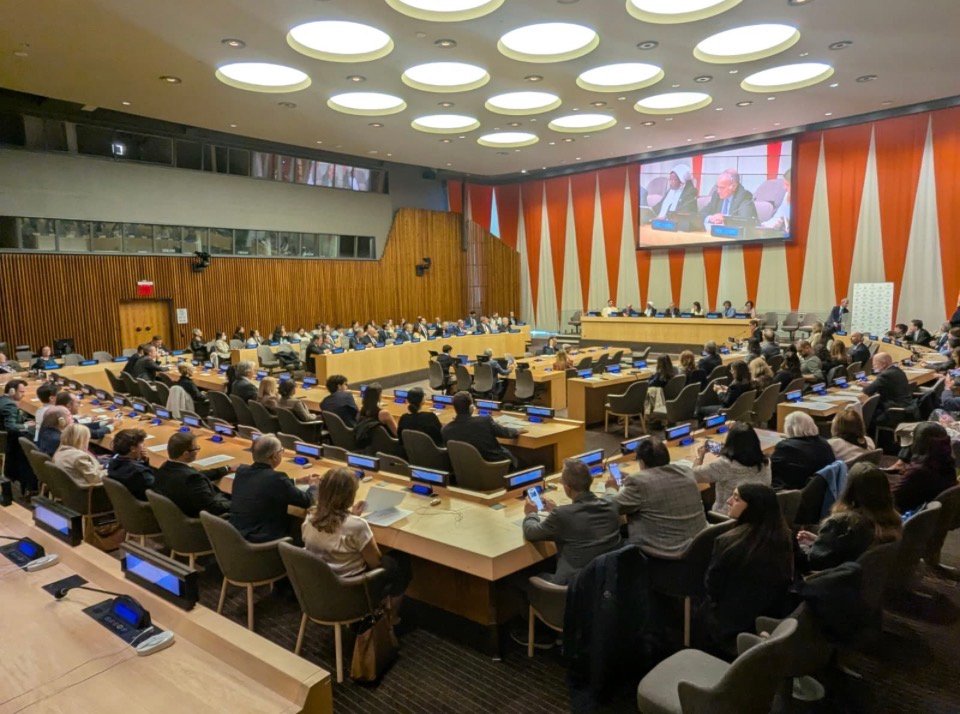
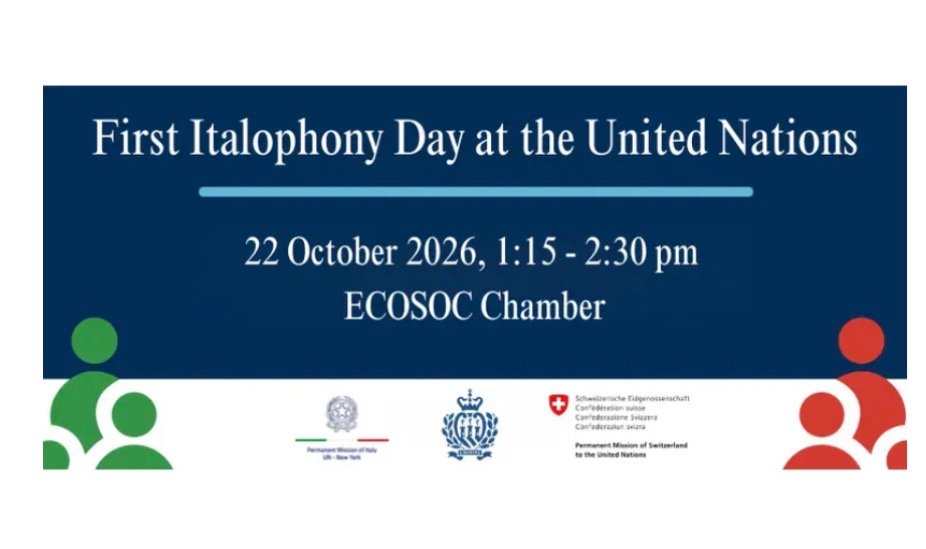
On October 22, 2026, the United Nations marked a historic milestone
with the first Italophony Day at UN Headquarters, bringing together
more than 300 participants in the Economic and Social Council
(ECOSOC) Chamber to celebrate the Italian language as an instrument
of cultural identity, creativity, diplomacy and international cooperation.
Organized by the Permanent Missions of Italy, San Marino and
Switzerland, the gathering represented an important step in
strengthening the international Community of Italian Speakers
(Comunità dell’Italofonia).
At the heart of the occasion was a simple yet meaningful question: What
is your favorite Italian word?
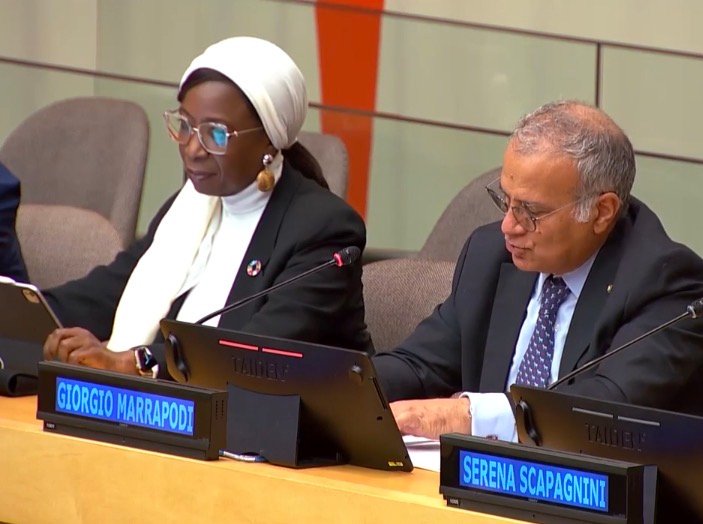
Italy’s Permanent Representative to the United Nations, Ambassador
Giorgio Marrapodi, selected amicizia — friendship — emphasizing the
capacity of language to transcend geographical and cultural boundaries
and encourage dialogue. In his opening remarks, Ambassador Marrapodi
stated:
“Today, we’ve been invited to share our favorite Italian word. I want to
choose the word friendship, amicizia, deeply rooted in Italian culture
that can transcend linguistic and geographical boundaries and can open
the way to dialogue with other cultures. More than 2,000 years ago,
Cicero in his De Amicitia already recognized the essential role of
friendship in fostering harmony and well-being of society and political
life. Looking at this room today, we know that we can count on many
friends here at the United Nations, and you know that you can count on
Italy.”
This historic occasion, held at United Nations Headquarters, known in
Italian as the Palazzo di Vetro (Glass Palace), traces its origins to
September 13, 2024, when Italian Deputy Prime Minister and Minister
of Foreign Affairs Antonio Tajani, speaking at the 84th International
Congress of the Società Dante Alighieri, expressed his desire to establish
a Day of Italophony. His proposal envisioned bringing together countries
and communities in which Italian is spoken, including San Marino,
Switzerland, Vatican City, Malta, and Italian-speaking populations
throughout Europe, the Americas, North Africa and beyond.
The vision took an institutional step forward on November 18, 2025,
when Tajani inaugurated the first International Conference on Italophony
at Villa Madama in Rome. The conference established the Community
of Italophony as a permanent forum dedicated to dialogue, cooperation,
cultural exchange and the promotion of the Italian language
internationally. Tajani characterized Italian as a language capable of
uniting rather than dividing, positioning the initiative not only as an
instrument of cultural promotion but also as a contribution to peace and
international understanding. Less than a year later, Ambassador
Marrapodi brought that vision to the United Nations.
The October 22 celebration featured diplomats, international officials,
scholars, artists, educators and students. A central moment was the
presentation of a declaration of commitment to the Community of Italian
Speakers, reinforcing its presence within the multilateral system.
The celebration coincided with the 26th edition of the Settimana della
Lingua Italiana nel Mondo (Week of the Italian Language in the World),
held October 19–25, 2026. Established in 2001, the international
observance marked 25 years of promoting Italian language and culture
through Italy’s diplomatic and cultural networks. The 2026 theme,
“Lingua geniale: ideare, progettare, creare con l’italiano,” highlighted
the Italian language as a living expression of ingenuity, design,
innovation and creativity. From literature, music and fine arts to
engineering, technology, fashion and gastronomy, Italian continues to
evolve while transmitting centuries of cultural knowledge.
The historic gathering also coincided with the 50th anniversary of the
Italian Heritage and Culture Committee of New York (IHCC-NY), a
pioneering organization in the establishment and promotion of Italian
Heritage and Culture Month in New York. Represented by Vice
President Maria Marinello, alongside fellow board members, the
committee joined the celebration at United Nations Headquarters,
marking the occasion during a milestone year in its own history.
For five decades, the Italian Heritage and Culture Committee has helped
preserve and promote Italian and Italian American heritage through
cultural programming, education and public celebrations. Its
participation at the United Nations reflected the enduring contributions
of Italian American organizations in safeguarding cultural identity and
transmitting the Italian language, history and traditions to future
generations.
The convergence of these milestones highlighted a shared commitment:
preserving the cultural inheritance of the past while creating
opportunities for its continued expression in an interconnected world.
Beyond the institutional significance of the occasion lies a deeply human
story: language is one of the most intimate forms of cultural inheritance.
During the United Nations celebration, students reflected on their
relationships with Italian. One described how the language had been lost
within the family as earlier generations sought to assimilate into
American society, and how studying Italian provided an opportunity to
reconnect with that inheritance. Such experiences demonstrate why
language preservation extends beyond vocabulary and grammar. It
concerns the transmission of memory, identity, traditions and belonging.
This philosophy is also reflected in the work of the Italian Language
Project, whose Word of the Day initiative encourages everyday
engagement with Italian language and culture. Through its website,
italianlanguageproject.org, the Italian Language Project promotes
linguistic and cultural preservation, creating opportunities for
individuals and communities to reconnect with their Italian heritage.
During Italian Heritage Month, the project’s founder, Mario Macaluso,
was a featured speaker at the Borough of Manhattan Community
College’s October 20 celebration, during the presentation entitled
“Reviving Italian American Culture One Word at a Time.” The initiative
illustrates how cultural safeguarding can begin with something as
accessible as a single word, allowing individuals to rediscover their
heritage while inviting new generations and communities to participate.
The question posed at the United Nations — What is your favorite
Italian word? — carries this same spirit of participation: every word has
the potential to reveal a memory, a relationship or a connection to a
cultural tradition.
The importance of the October 22 milestone was reinforced on
November 2, 2026, when Italy addressed the 81st United Nations
General Assembly during its debate on questions relating to information.
Italy emphasized multilingualism as an essential component of an
inclusive and accessible United Nations, recalling its co-sponsorship of
General Assembly Resolution 80/310 on multilingualism. The statement
specifically recognized the first Italophony Day and the enthusiastic
participation of young people, identifying linguistic diversity and youth
engagement as important contributions to multilateral cooperation.
In an increasingly interconnected world, preserving cultural heritage and
encouraging innovation are not competing objectives. They are
complementary responsibilities. The first Italophony Day at the United
Nations therefore represents more than the celebration of a language. It
demonstrates how cultural identity can serve as a foundation for
meaningful international dialogue without being limited by nationality,
borders or ancestry.
A language lives through those who speak it, those who rediscover it and
those who choose to carry it forward. And as the first Italophony Day at
the United Nations and the Italian Language Project demonstrate,
sometimes preserving that inheritance begins with just one word at a
time.